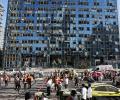
Scenes from war-torn Iran and Israel.

Amidst ongoing conflict, Iranian President Masoud Pezeshkian signals a potential de-escalation by apologising to neighbouring countries while firmly rejecting US President Donald Trump's demand for unconditional surrender.

He also criticised the possible succession of the son of the late supreme leader of the Islamic Republic, Mojtaba Khamenei, who is widely viewed as a leading contender for the position.

The Ministry of External Affairs (MEA) reports that over 1,150 Indian nationals have been evacuated from Iran through land borders into Armenia and Azerbaijan since the start of the West Asia conflict. The MEA also confirmed that three Indians were injured in attacks in the UAE.
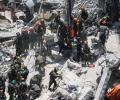
He made the comments while visiting the site of an early morning Iranian missile strike in the city of Bat Yam, close to Tel Aviv.

Donald Trump claims the US military decimated Iran's Navy and Air Force, hinting at regime change while Iran accuses the US and Israel of planning a ground invasion.

Israel initiated military action against Iran shortly after Prime Minister Narendra Modi's visit, capitalising on a fleeting opportunity and years of strategic preparation, according to Israel's ambassador to India.

The escalating conflict in West Asia widened on Monday as Israel launched airstrikes on Hezbollah targets in Beirut and other parts of Lebanon, following projectile fire from Lebanese territory into northern Israel. The Israeli Air Force (IAF) said in a series of posts on X that it carried out targeted strikes against senior members of Hezbollah in the Beirut area in response to the projectile fire launched toward Israel, particularly toward the north of the country.

Israel will continue its offensive in South Lebanon aimed at neutralising the threat from Hezbollah, which is backed by Iran.
China has condemned the attack on an elementary school in Iran and pledged USD 200,000 in emergency humanitarian assistance.

Israeli Prime Minister Benjamin Netanyahu has asserted that Iran is no longer capable of enriching uranium or producing ballistic missiles, following a joint military campaign with the US.

The delegations from the US and Iran head to Islamabad on Friday, carrying a ceasefire that is already fraying, a Strait that is technically open and practically closed, and a negotiating agenda that would challenge even parties actually negotiating in good faith, which these groups are not. Prem Panicker continues his must read blog on the Iran War.
Iranian President Masoud Pezeshkian maintained a stance of defensive necessity, noting that Tehran is "forced to retaliate to attacks" but clarified that this does not imply a dispute with neighbouring countries

The BSE Sensex and the Nifty 50 declined around 4.5 per cent each since the start of the West Asia conflict.

Following attacks in West Asia, hundreds of Indians, including prominent personalities, are stranded in Dubai and other key hub airports due to flight disruptions, prompting appeals for government assistance.

'Our diplomacy should have been focused on preventing war and avoiding the inevitable disruptions it would cause, posing a real risk to India's growth story,' asserts former foreign secretary Shyam Saran.
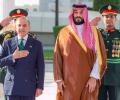
Prime Minister Shehbaz Sharif met with Saudi Crown Prince Mohammed bin Salman to express Pakistan's support for the Kingdom amidst escalating tensions in West Asia, reaffirming their mutual defence pact and commitment to regional stability.

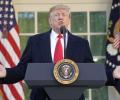
United States President Donald Trump on Friday declared that there would be 'no deal with Iran except unconditional surrender' amid the escalating West Asia conflict, asserting that Tehran must capitulate before any diplomatic negotiations can proceed.

Chinese foreign ministry spokesperson Mao Ning said that the country believes that dialogue and negotiation are the only viable solutions to resolving disputes and that the continued escalation of the conflict serves no one's interests.

IDF international spokesperson Lt Col Nadav Shoshani said the Israeli military targeted several Hezbollah positions, including command and control centres, launch sites and senior operatives.

'Moments like this remind us how fragile life really is.'

Pakistan is set to host face-to-face talks between the United States and Iran, aiming to solidify a fragile ceasefire and prevent further conflict in West Asia. The discussions will focus on a long-term peace arrangement, including sanctions relief, regional security, and Iran's nuclear program.

The purge in Washington does not pause the war. Strikes continue, Hormuz remains closed, and Brent crude is still dancing around $109 a barrel. For India, the command chaos in the Pentagon is another layer of uncertainty piled on five weeks of conflict that was already straining every buffer Delhi has.
On Tuesday night, Iran launched over a dozen ballistic missiles targeting at least two bases where US military and coalition forces' are stationed in Iraq to 'avenge the killing' of General Qasem Soleimani.

'The next two to three weeks will not be decided in Washington.' 'They will be decided in Tehran, in whatever calculation Iran makes about the costs of continued resistance against the costs of appearing to have yielded.'

Iranian Foreign Minister Seyed Abbas Araghchi has warned the United States that Iran is ready to confront American troops if the US launches a ground invasion, calling such a move a potential 'big disaster' for Washington.

'The US landed in this war without planning. The US felt that if they kill Ayatollah Khamenei the people of Iran will come out on the roads and do a regime change.' 'On the contrary, the US bombings on Iran has united the entire nation.'

'Was the five-day pause ever meant to hold, or was it simply another instrument of signaling, of positioning, of buying time in a war where even the pauses are tactical?' asks Prem Panicker in his must read daily blog on the Gulf War.

Amidst escalating tensions in West Asia, Pakistan's defence chief visited Saudi Arabia to discuss regional security and the mutual defence pact between the two nations, focusing on de-escalation strategies.

When missiles fly in this region, they are never just aimed at military targets.

Economist Jeffrey Sachs saw Gulf nations' decision to partner with the US through the Abraham Accords as an "invitation for disaster" as it made them more dependent on American protection.
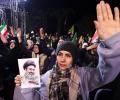
In the video, the Supreme Leader can be seen teaching religious studies to a group of pupils who are listening attentively. The IRIB said that the video of Ayatollah Mojtaba Khamenei was published for the first time.

The 'rescue' operation occurred within kilometres of Iran's underground tunnel complex at Isfahan, assessed by the IAEA and US intelligence as holding a substantial portion of the country's 60 per cent enriched uranium stockpile. Retired senior US military officers have highlighted that the mission's footprint -- hundreds of special operators, multiple heavy-lift aircraft deep inside Iran -- appears outsized for recovering a single airman. Prem Panicker continues his must read blog on the Iran War.

For years, these two powers operated as "frenemies" in the shadow of Iran's regional influence. The frame here is "The Enemy of My Enemy."

Secretary of State Marco Rubio urged its citizens to immediately depart from several Middle Eastern countries, citing "serious safety risks."

Iran launched retaliatory military strikes targeting Israel and American military bases across the region, including in Qatar, the United Arab Emirates, Kuwait, Bahrain and Jordan.
Tensions escalated dramatically on March 5, 2026, as the United States and Israel launched coordinated strikes on Iran, triggering retaliatory explosions across Tehran, Sanandaj, and beyond.

Trump may strike. He may announce productive talks and extend again. He may do both at the same time. Iran will not open the Strait on someone else's terms, so no matter what happens, that problem will remain unsolved. And the IRGC will still be collecting its $2 million toll from every ship bold enough to ask permission to pass.

This weekend, Donald Trump has begun to say the quiet part out loud -- that he wants to take control of Iran's oil, a formulation more in line with his robber-baron style of international relations.

Prime Minister Narendra Modi spoke with Iranian President Masoud Pezeshkian to discuss the escalating tensions in West Asia, emphasising the safety of Indian nationals and the need for regional stability through dialogue and diplomacy.
 © 2026 Rediff.com - Advertise with us - Disclaimer - Privacy Policy - Sitemap - Feedback - About us - Terms of use - Grievances